Wet basements in a city built on basements
Basements are common in the North Ridgeville area, and northern Ohio's snow, spring thaw and heavy rain seasons test them every year. A basement stays dry when the ground water has somewhere to go, and that somewhere is usually a sump pit, a drain line or the storm system outside.
The city's Public Utilities Division bills sanitary sewer and stormwater as separate services to more than 15,000 accounts. That split matters in your basement: clear groundwater belongs in the stormwater path, while household waste belongs in the sanitary sewer. A sump pump aimed at the wrong place can cause trouble, so ask the Building Division at (440) 490-2081 about discharge before you plan the install.
Floor drain and sump work follows the Ohio Plumbing Code, built on the International Plumbing Code (IPC).
The same issues show up across the border in North Olmsted, where much of the housing dates to the postwar boom, though each city has its own rules.
Common questions
No. We handle the plumbing side: drain tile, sump pumps, floor drains, window well drains and backup protection. If a crack or bowing wall looks structural, we say so and suggest the right specialist.
Rules for where discharge can go differ by property and system, so ask the Building Division at (440) 490-2081. Clear groundwater and household waste belong in separate systems.
It is a one-way valve on the building drain that closes if the sewer pushes waste back toward the house. It has to be accessible for service, and installation may need a permit.
Heavy rain can load the sewer or storm system, pushing air or water back. A blocked branch, a dry trap or a main line problem can do the same thing, and a camera look sorts out which.
Groundwater follows rain and thaw. A pipe leak shows up on dry days and may track with water use. A plumber checks supply and drain lines to rule it out.
Interior drain tile and sump pits: the plumbing-side fix
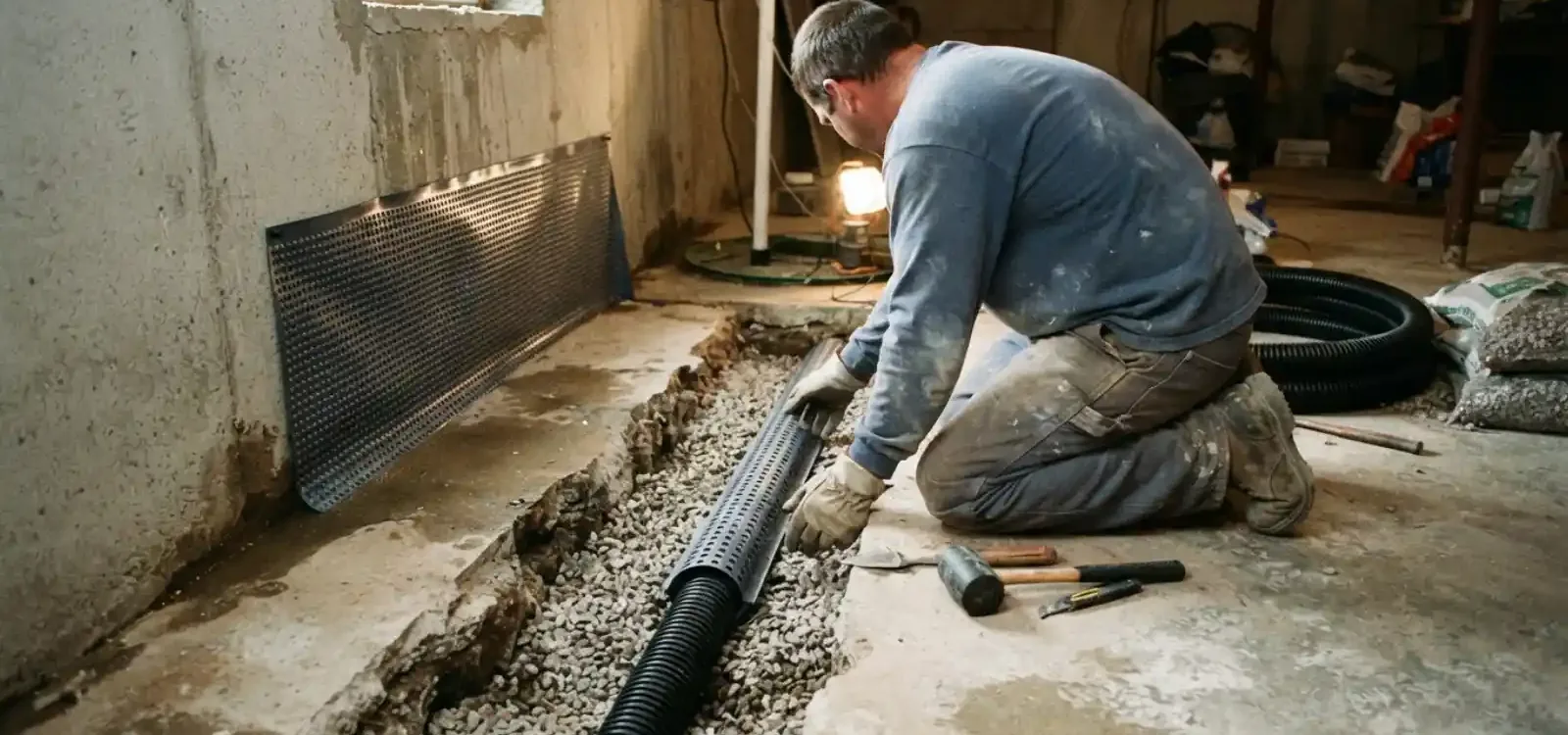
Interior drain tile is a perforated pipe set in gravel along the inside edge of the basement floor, usually along the footing. Groundwater that reaches the floor edge enters the pipe, runs to a sump pit and gets pumped out. It manages water at the floor level rather than stopping it at the wall.
That job requires cutting a channel in the slab, setting the pipe, backfilling with gravel and patching the concrete. The pit holds the pump and a float switch, and the pump lifts water through a discharge line outside. If you already have a pit and want to know whether the pump is healthy, see sump pump repair.
Floor drains, window wells and sewer backup protection
Not every wet basement is a groundwater problem. Three other sources are plumbing issues and often simpler to fix than people expect.
- Floor drains collect spills and laundry overflow. A dry drain trap can let sewer gas into the room, and a blocked drain backs up. A cleaning or camera look usually settles it. See drain cleaning.
- Window wells collect rain against the glass. A well without a drain or with a clogged one fills like a bucket and can leak through the frame.
- Sewer backup happens when the sewer line or main is blocked and waste pushes into the lowest drain. A backwater valve on the building drain can stop it from coming in.
A camera look at the line, as in sewer camera inspection, shows whether backups come from your pipe or the main.
How a plumber works out where the water is coming from
- 1Ask when the water appears. Water after heavy rain points to groundwater or a window well. Water on a dry day points to a pipe or a drain.
- 2Look at the floor edges and walls. Staining, mineral lines and dampness show where the water enters.
- 3Test the drains. Water poured into floor drains shows whether they flow, trap or back up.
- 4Check the sump system. The plumber lifts the float, watches the pump run and looks at the discharge line.
- 5Inspect plumbing lines. A leak from a supply or drain line can look like groundwater, so pipes in the ceiling and walls get a check.
If the water is clear and enters at one spot after a leak test, leak detection may be the faster route than any drain work.
Basement taking on water?
Tell the plumber when it appears and how much. Same-day appointments are available when a slot is open.
Planning the work before the next wet season
Waterproofing works best when you start between storms, not during one. These steps get a project moving.
- Note where and when water shows up, including how high it rises and what the weather was.
- Look at your gutters and downspouts so rain is carried away from the wall.
- Ask about a permit before any cutting or new discharge line. Permit rules vary.
- Decide on a battery backup for the sump pump if the power goes out in storms.
Drain tile, pump or backwater valve: which fits your basement
| Water source | Plumbing-side fix | What to know |
|---|---|---|
| Groundwater rising at the floor edge | Interior drain tile and sump pump | Cuts the slab, so plan for patching |
| Pit overflows or the pump keeps running | Pump replacement or a second pump | A failed float or clogged line is common |
| Sewage backs into a floor drain | Backwater valve, main line cleaning | Valves need access and a permit |
| Window well fills and leaks | Well drain connection or cover | Check that the drain is open |
| Wet spot with no rain | Leak detection on supply and drain lines | A pipe leak is not a waterproofing issue |
A main sewer line that backs up is best cleared first with sewer line cleaning, then protected with the valve.
What moves the price of a waterproofing job
No honest number comes without seeing the basement. These are the factors.
Drain tile along one wall is a smaller job than a full perimeter. More concrete to cut and patch means more time.
The size of the pit, the pump's capacity and whether you want a backup all affect the parts list.
A short discharge to a yard is simpler than a long run. The route and any city rules shape the work.
Finished basement walls or heavy storage slow the work and add repair steps.
Work that changes the water supply or sanitary sewer needs a permit, and inspections are scheduled at least 24 hours ahead.
Insurance often covers sudden water damage but not slow seepage, wear or lack of maintenance. Sewer backup is typically an add-on. For a real number, call the line and describe where water shows up.
Signs your basement needs attention
- Damp, musty smell that returns after cleaning. Moisture is still getting in.
- White chalky mineral lines along the floor edge or base of the wall.
- A sump pump that runs constantly or does not run during a storm.
- Water pooling at one corner after heavy rain.
- Gurgling floor drains during storms or when the washer runs.