Start with the water you actually have
We do not quote hardness numbers or claim anything about your water source here, because the right answer comes from testing, not from a webpage. A home test kit or a lab test of your tap shows what is in the water at your house.
For the supply side, the City of North Ridgeville Public Utilities Division can answer questions about the water quality report. Call (440) 490-2049, Monday to Friday, 8:00 a.m. to 4:30 p.m. The division bills water, sanitary sewer, stormwater and refuse to more than 15,000 accounts.
Armed with a test result, you can ask a plumber for treatment that fits the problem. Without one, you risk paying for a system that does not match. Neighbors in Avon and nearby towns may get different results, so use your own test.
What drives the price of a softener or filter install
The equipment itself is only part of the cost. Installation depends on your house, and the plumber should explain each line before work starts.
A salt-based softener, a carbon filter and a whole home multi-stage system each need different parts and different plumbing.
A unit set near the main shutoff in an open basement is simple. A long run to a distant utility room adds pipe.
A softener needs a drain for its regeneration cycle and often a nearby outlet. Missing either adds work.
A bypass lets you service the unit without shutting the house down. The plumber includes it in the plan.
Changes to the water supply may need a permit, and permit rules vary.
Insurance does not cover a planned treatment upgrade. A real number requires a look at your main line and utility room, so call the line and describe what you want to treat.
Common questions
Test your tap and read your water utility's annual water quality report. Spotting on fixtures and scale in the kettle are clues, but a test is what tells you what a system should do.
A softener exchanges minerals using a resin bed. A filter removes particles or certain tastes and smells. Some homes use both, and a test tells you which.
Yes. Regeneration flushes brine to a drain, and the line needs an air gap. The plumber plans the route before installing.
Common causes are a salt bridge, a clogged brine line, spent resin or a failed control head. A plumber checks each and tells you whether repair is worth it.
Ask the City of North Ridgeville Public Utilities Division at (440) 490-2049. It handles water billing and can point you to the annual report.
Permit rules vary, so ask the North Ridgeville Building Division at (440) 490-2081. Changes to the water supply often require one.
Usually, yes. A sediment or carbon stage goes upstream of the softener on the main line. The plumber checks space, flow and bypass setup first.
How a softener or filter gets installed
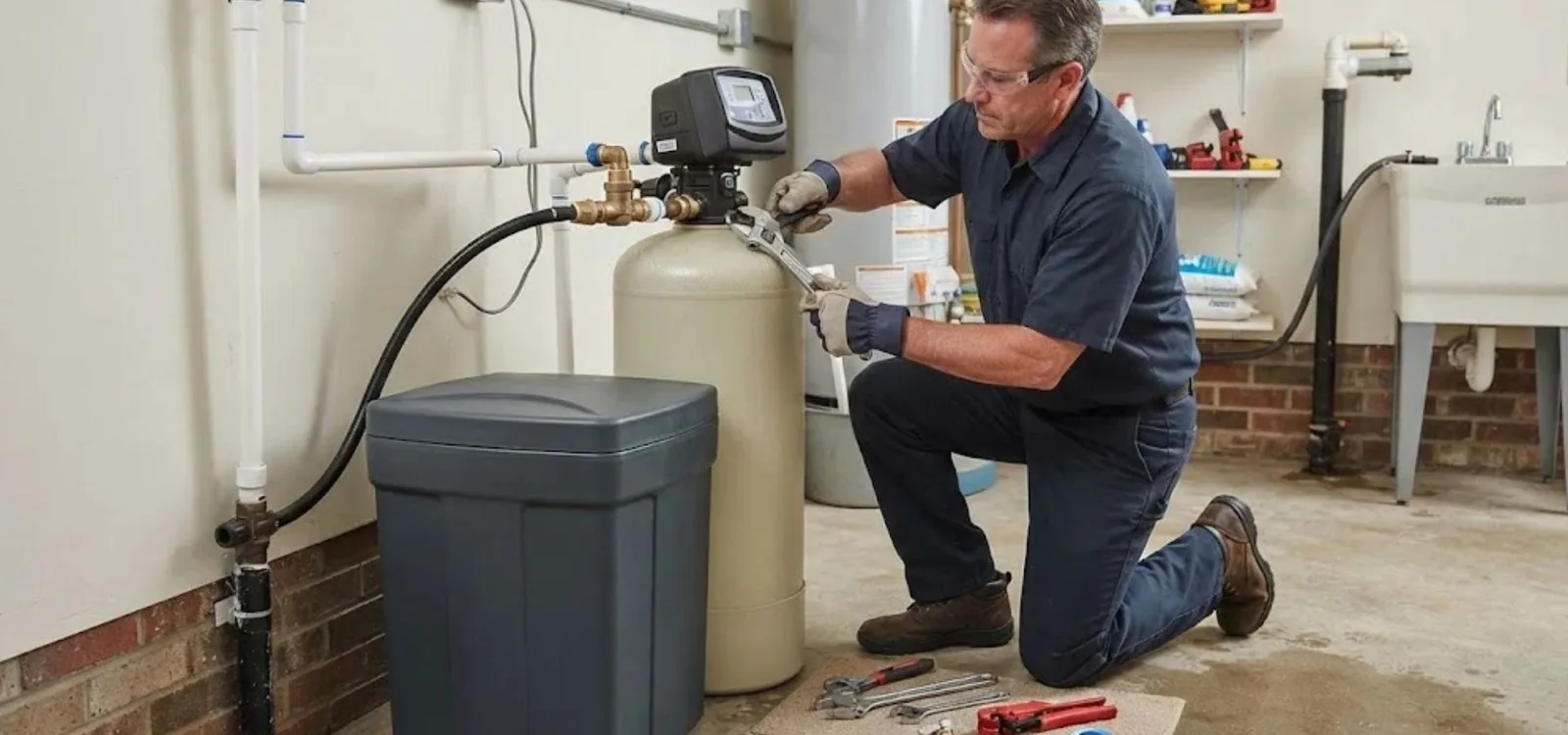
- 1Choose the spot. The unit goes on the main line after the meter and before the water heater, with room for service and a nearby drain.
- 2Shut off and cut in. The plumber closes the main, drains the line and adds fittings for the inlet and outlet.
- 3Add a bypass. Valves let water flow around the unit during service.
- 4Connect the drain. The regeneration drain line runs to an approved drain with an air gap.
- 5Set up and flush. The plumber starts the unit, runs the first cycle and checks for leaks.
- 6Explain the settings. You get a plain walk-through of salt, filters and when to change them.
Signs a softener or filter needs attention
Whether the system is new or old, these signs say something has changed.
- Spots or scale returning on glass, faucets and showerheads after the unit worked well before.
- Soap that does not lather or skin and hair that feel different after a shower.
- The brine tank is full of salt but the water has not changed. A salt bridge or a stuck valve may be the cause.
- Low water flow through the house. A clogged filter or a failing control head may be to blame.
- Water that smells or tastes off. Test your tap again before deciding what to change.
Ready to treat your water?
Bring your test result to the call and a plumber can plan the install and give you a clear price.
Softener, filter or both: choosing the right system
| What you want to change | Common option | Planning note |
|---|---|---|
| Scale and spotting | Salt-based softener | Needs a drain and salt supply |
| Taste or smell | Carbon filter | Filter changes are regular upkeep |
| Sediment or cloudiness | Sediment filter | Often the first stage in a larger system |
| Several concerns at once | Whole home multi-stage system | A test guides the stages |
| Drinking water only | Under-sink filter | Smaller job, treats one tap |
If you are replacing old supply lines, treat the water after the repipe is done. See whole house repiping if rusty pipes are your main concern.
Permits and finding a plumber for water treatment
North Ridgeville requires a permit for alterations that involve changes to the water supply. Whether a given softener install needs one varies, so ask the Building Division at (440) 490-2081. Inspections must be scheduled at least 24 hours ahead.
Installation follows the Ohio Plumbing Code, built on the International Plumbing Code (IPC), including how the drain line is connected.
Ohio does not require a state license for residential plumbing contractors, but North Ridgeville requires contractors to register with the city. Ask for proof of insurance, read the written contract and be wary of anyone who refuses to pull a permit when one is needed.
Repairing a water conditioner and adding whole home filtration
A conditioner that has stopped softening usually has a mechanical cause. The control head may have failed, the resin bed may be spent, the brine line may be clogged or a salt bridge may have formed in the tank. A plumber checks each in turn.
Adding whole home filtration to an existing softener is a common project. The filter goes before the softener on the main line, so it catches sediment before it reaches the resin. If the softener is old and has been repaired more than once, replacement may make more sense.
A new install on a new water line, for example after a main line replacement, is covered under water line repair and can be coordinated so the treatment system fits the new routing.
Before you buy: what a softener will and will not do
A softener changes how minerals in the water behave. It does not make water safe if safety is the concern, and it does not fix low pressure, rusty pipes or a leak. If your water has a safety issue, ask the Public Utilities Division at (440) 490-2049 and your health department, not a salesperson.