A newer house still has a main line that can fail
North Ridgeville grew from 13,152 residents in 1970 to 35,280 in 2020, so many homes here are far younger than the typical Ohio house. That does not make the buried sewer pipe maintenance-free, because roots find any loose joint and grease coats any rough wall. The point for you: judge the line by what a camera shows, not by the year on the deed.
Your private line ties into the city sanitary sewer, and the city's interceptor lines carry flow on to the French Creek Wastewater Treatment Plant in Sheffield Village. If the whole street is backing up, call the Public Utilities Division at (440) 490-2049, because the blockage may sit in a city main. Neighbors in Avon feed the same plant, yet each town handles its own side of the pipe.
Common questions
Yes. The line is open 24/7, including holidays. If sewage is rising in a floor drain or tub, call right away and stop running water while you wait.
Drain cleaning clears a branch that serves one fixture, such as a sink or tub. Sewer line cleaning clears the large main that carries all those branches out of the house, using bigger machines and usually a camera.
A quick return usually means something on the pipe wall rebuilds the blockage: roots, grease, or a belly that holds water. Another cable pass will not change that, so ask for a camera look.
Only your fixtures backing up points to your own line. A whole street with the same trouble can mean a city main, so also call North Ridgeville Public Utilities at (440) 490-2049.
Yes. You get a clear price once the plumber sees the job. If the camera shows a break or the scope changes, work stops until you have the new price.
There is no single schedule. A pipe with a history of roots may need regular visits, while a clean line may never need one. A camera pass after the first cleaning shows which case you have.
Main line or single drain: which pipe is actually blocked
A branch drain serves one fixture. The main line collects every branch and leaves the house, so when it clogs, the lowest drain gives up first. That is usually a basement floor drain, a basement shower or a laundry standpipe.
If only the kitchen sink is slow, you need drain cleaning on that branch, and a machine in the main line would be wasted. If two or more fixtures slow down together, or the floor drain bubbles when you flush, the plumber starts at the main cleanout instead. Telling the dispatcher which fixtures misbehave saves a trip.
How a plumber clears the main line, step by step
- 1Find the cleanout. This is a capped fitting on the main, often in the basement near the foundation wall or outside near the house. Opening it relieves pressure, so the plumber stands clear and works slowly.
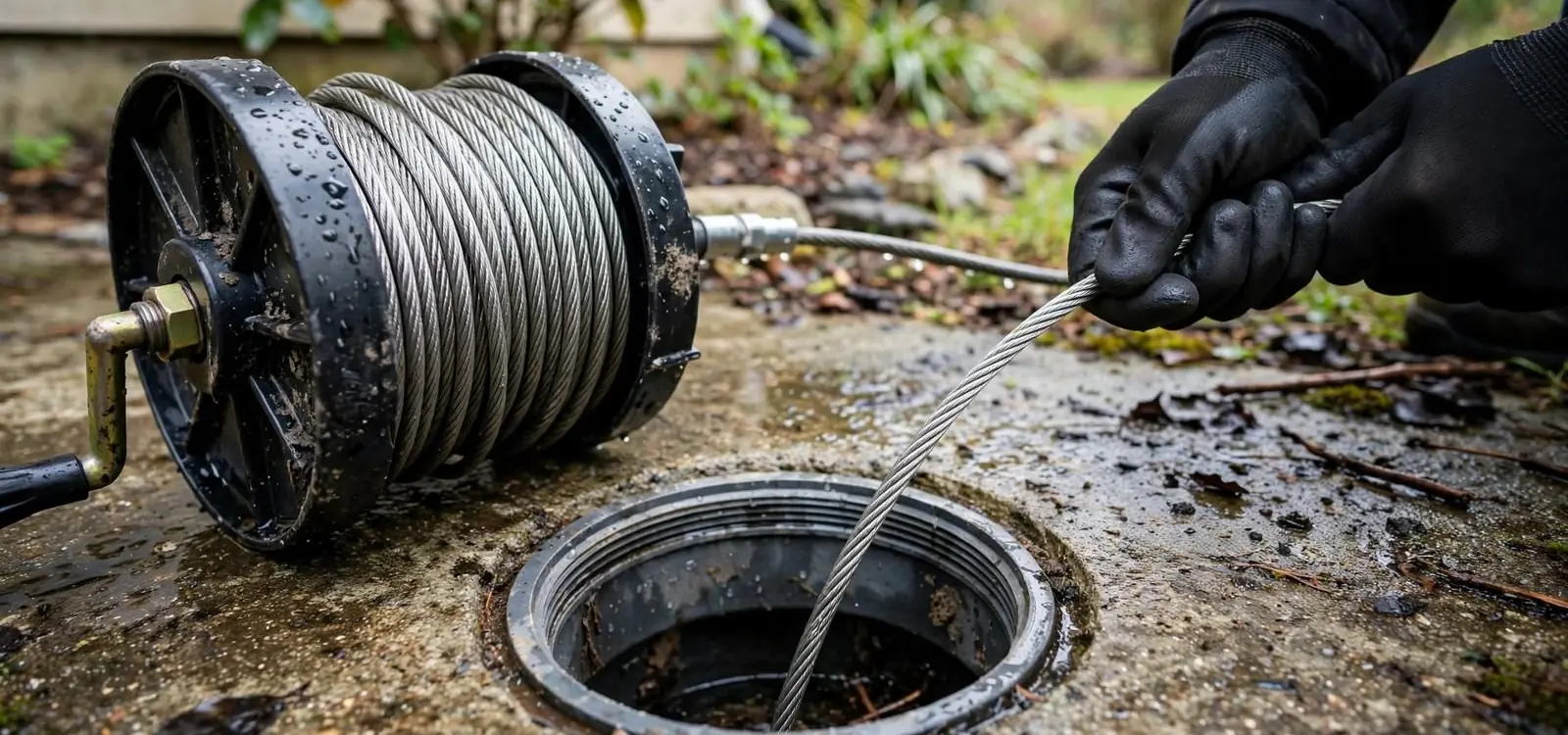
- 2Choose the machine. Soft buildup and paper take a rodding machine with a spinning head. Roots take a cutting head. Heavy grease or scale takes a jetter.
- 3Clear, then re-run the pipe. One pass through the blockage proves nothing. The plumber runs the machine back and forth until the line is open the whole way.
- 4Send the camera down. The picture shows roots, a belly, a cracked section or a joint that has shifted, so you know whether the cleaning is the fix or only the first step.
- 5Flow-test the house. Water runs through the fixtures together before the plumber calls the line open.
Rodding opens a channel. Hydro jetting scours the whole pipe wall with high-pressure water, which matters when the same clog returns every season.
Sewage is backing up right now: what to do while you wait
A main line backup can put dirty water on a finished floor quickly. These steps keep it small.
- Stop all water use: showers, laundry, dishwasher and flushing. Every gallon you send down goes to the lowest drain.
- Keep out of the standing water. It carries bacteria, and a wet basement floor near outlets or a furnace is an electrical risk.
- Do not pour drain chemicals into a stopped main. They sit in the pipe and burn the plumber who opens it.
- Move belongings off the basement floor and away from floor drains and utility sinks.
- Leave the cleanout capped unless the plumber on the phone says otherwise. A full pipe can spill when the cap comes off.
Rodding, jetting or camera first: picking the right approach
| Situation | Usual approach | Reason |
|---|---|---|
| First backup, no history | Rodding machine, then camera | Opens the line and shows what caused it |
| Roots seen on a past camera pass | Cutting head, then scheduled repeat visits | Roots regrow, so the cleaning has to repeat |
| Grease or scale coating | Jetting | Water scours the full wall instead of boring a hole |
| Clog returns within weeks | Camera before anything else | Repeat clogs often mean a belly or cracked pipe |
| Camera shows a collapsed section | Stop cleaning, plan a repair | Machines cannot fix a broken pipe |
When the picture shows a break or a shifted joint, cleaning only buys time. The lasting answer is sewer line repair, and a standalone sewer inspection gives you the footage to compare quotes.
Sewage rising in the basement?
The plumber on the line can walk you through the first steps while a visit is arranged.
What decides the price of cleaning a sewer line
These are the factors that move the price, and we go through the ones that apply before any work starts.
A working cleanout near the house makes the job simpler. If there is none, the plumber may need to pull a toilet or open another access point, which adds work.
Paper and soft buildup clear quickly. Roots and hardened grease need a cutting head or jetter and more time on the line.
A rodding machine, a jetter and a camera are different setups. The price follows the tool that fits your pipe, not the biggest one on the truck.
A camera pass costs extra time but tells you if the cleaning is enough. After a repeat clog it is usually worth it.
Night, weekend and holiday visits are priced differently from a planned daytime appointment, and you hear which applies before the plumber starts.
Most homeowner policies cover sudden accidental damage but not wear, roots or the clog itself, and sewer backup is often an optional add-on. Ask your insurer before you need it. For a real number on your line, call and describe which fixtures are backing up.
Warning signs the main line is closing up
- Gurgling in a toilet after the washer or a shower drains. Air is pushed past a partial blockage.
- A basement floor drain that smells or bubbles when water runs upstairs.
- Slow drains in more than one room at the same time, not just one sink.
- A clog that returns within weeks after a cleaning, a sign of roots or a belly.