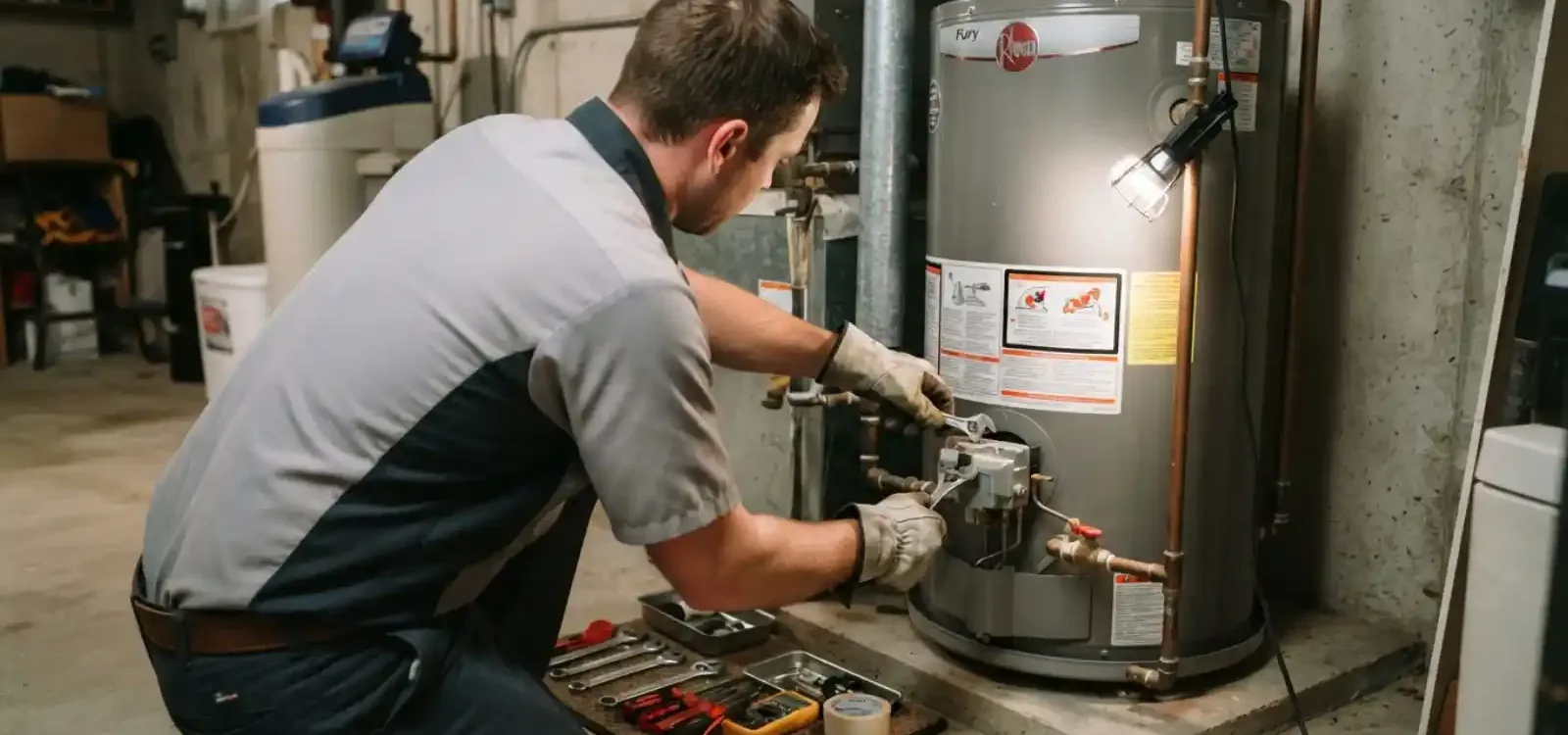
Basement tanks, city water and what they mean for your heater
North Ridgeville grew from 13,152 residents in 1970 to 29,465 in 2010, so many houses here are on their second or third water heater. Basements are common in northern Ohio, and a tank sitting in one can leak for days before anyone notices. When you call, say where the heater sits and whether the floor beside it has a drain, because that decides how fast a small drip becomes real damage.
Water reaches your house through a city meter, and the Public Utilities Division at (440) 490-2049 handles water and sanitary sewer billing. A quiet leak at the tank often shows up first as a higher bill. A part swap usually stays a repair, but a full tank change may need paperwork, and permit rules vary, so ask the North Ridgeville Building Division at (440) 490-2081 before a replacement is scheduled.
Any part that touches the relief valve or gas connection is repaired to the Ohio Plumbing Code, which is built on the International Plumbing Code (IPC).
Our plumbers also reach Avon and North Olmsted. Repair steps are the same there, but each city runs its own permits and utility accounts.
Common questions
Yes. The line is open 24/7, including nights, weekends and holidays. If a tank is leaking, close the cold supply valve above it and switch off the power or gas, then call.
Bottom leaks come from the drain valve or from the tank itself. A weeping drain valve is a small repair. Water seeping from the base of the steel shell means the tank has corroded through and needs replacing.
On electric units, check the breaker and the red reset button on the upper thermostat. On gas units, check whether the pilot is lit. If either fails again after a reset, call, because repeating resets can damage the part.
Codes differ between heat pump, gas and electric units, so the label and manual matter. Write down the code and any blinking pattern before calling. The plumber can usually tell whether it points to a sensor, an element, a venting issue or a control board.
Yes for the water side, the electric backup elements, the condensate line and the plumbing connections. Sealed refrigerant faults and control board failures may need the manufacturer's service channel, and we say so before you pay for a visit.
A part swap usually does not, but a full tank change may. Permit rules vary, so ask the North Ridgeville Building Division at (440) 490-2081, which can tell you what applies to your address.
Yes. You get a clear price once the plumber has found the fault and before work begins. If the scope changes after that, work stops until you have agreed to the new number.
Water under the tank: is it a repair or the end of the tank
A leaking water heater is the call we hear most often on this service, and the source of the water decides everything. It can come from a fitting on top, from the pressure relief valve, from the drain valve near the floor, or straight through the tank wall. The first three are repairs. The last one is not.
- Drip at the top connections: a loose or corroded inlet or outlet fitting. This is a quick repair if the metal around it is sound.
- Wet pipe beside the relief valve: the valve may be worn, or house pressure may be climbing when the tank heats. An expansion tank problem can cause the second case.
- Weeping drain valve at the bottom: the valve seat has worn. Swapping the valve fixes it, as long as the tank near it is not rusted through.
- Water from the bottom seam or jacket: the steel tank has corroded from the inside. No part replaces a failed tank shell.
- Damp surface with no drip: cold pipes can sweat in humid basements and mimic a leak. Dry everything and look again after a short wait.
When the tank shell has failed, repair spends money on a unit that cannot be saved. At that point the honest move is a swap, and the plumber will say so before any parts are ordered. If the water is coming from a pipe and not the heater, leak detection finds where it starts.
Electric, gas and heat pump tanks fail in different places
An electric tank has two heating elements and two thermostats. If the upper element dies you get no hot water at all. If the lower one dies, hot water runs out far sooner than it used to. A tripped high-limit reset button or a breaker that will not stay on points to a shorted element, and resetting it again just repeats the fault.
A gas tank depends on a pilot or igniter, a thermocouple that proves the flame, a gas control valve and a clear flue. A pilot that will not stay lit is often a worn thermocouple or a draft problem. If you smell gas, leave the house and call the gas utility or 911 first, then call us.
Hybrid heat pump units add a fan, a compressor, a condensate drain and backup electric elements. The plumber can handle the water side, the elements and a clogged condensate line. Sealed refrigerant faults and control board failures sometimes belong with the maker's service channel, and we tell you that plainly instead of guessing.
A tank that makes no hot water at all, with no leak, is usually a power or ignition fault. Check the breaker or pilot, then call.
What the plumber checks before replacing a single part
- 1Make it safe. Power or gas is switched off and the cold supply is closed before any panel comes off.
- 2Trace the water. A dry towel run along fittings, valves and the tank base shows where the moisture starts.
- 3Test the heat path. A meter reads each element and thermostat on an electric unit. On gas, the plumber checks the pilot, thermocouple, burner and flue draft.
- 4Test the safety valve. The pressure relief valve should open and reseat. A valve that will not close is replaced, not tolerated.
- 5Look at sediment. Draining a little water shows scale and grit. Heavy buildup insulates the burner or covers the lower element and shortens its life.
- 6Confirm under load. Hot water runs at a faucet until the tank recovers properly.
The anode rod inside the tank is a sacrificial metal rod that corrodes so the steel does not. If it is spent, the tank wall is next. Checking it shows how much life is left.
Water heater down right now?
Describe the leak or the cold shower and a plumber will walk you through the safe first steps.
When to shut everything off and call right now
Most water heater problems are inconvenient. A few are dangerous, and they are worth treating as emergencies.
- Steam or hot water from the relief valve pipe: the tank is over pressure or over temperature. Switch off the heat source and keep people away.
- Any gas smell: leave the building and call the gas utility or 911 before you call a plumber.
- Water reaching the electrical panel or outlets: shut off the main breaker only if you can reach it dry, otherwise stay out.
- Rumbling, popping or banging from the tank. Sediment is boiling under the heating element.
Close the cold supply valve above the tank so it stops refilling. If the leak is heavy, shut off the main water supply to the house.
Fix it or replace it: how the decision usually goes
| What you see | Usually | Why |
|---|---|---|
| Dead element or thermostat, tank dry outside | Repair | A small part on a sound tank is worth fixing |
| Pilot will not stay lit | Repair | Thermocouple or draft issues are small jobs |
| Leak from the tank bottom or seam | Replace | A corroded steel shell cannot be patched |
| Rusty hot water and a long list of past repairs | Replace | The inside of the tank is likely failing |
| Relief valve dripping with high house pressure | Repair, then check pressure | The valve is reacting to a pressure problem upstream |
If the repair bill is approaching what a new unit would cost, a replacement is often the better use of the money. A tankless unit is another route, though it changes gas, venting and electrical needs and deserves its own conversation.
What decides the price of a water heater repair
A fair price depends on what is actually broken. These are the factors that move the number, and the plumber explains which ones apply before work starts.
An igniter or thermostat is a small part. A gas control valve or a relief valve with a corroded seat costs more and takes longer.
Electric, gas and heat pump tanks use different parts and different test methods, and hybrid units need more diagnosis time.
A tank in an open basement is quick to reach. One in a tight closet or crawlspace takes more time, and old shutoff valves that will not close add work.
A sound tank makes a repair worthwhile. A corroded one turns the visit into a replacement discussion.
Night and weekend visits are priced differently from a planned daytime appointment, and you hear which applies before anything starts.
Most homeowner policies cover sudden accidental water damage but not wear, age or maintenance, so a worn-out tank that leaked slowly may not be covered. A tank that burst suddenly sometimes is, so ask your insurer. For a real number, a plumber needs to look at your heater, so call the line and describe what you see.
Signs your water heater is on its way out
- Hot water runs out quickly, or the temperature swings. A lower element or a layer of sediment is the usual cause.
- Rust-colored water from hot taps only. The tank interior or the anode rod is corroding.
- Water takes a long time to heat after a shower. A failing element or a burner coated in scale.
- A metallic or rotten-egg smell from the hot side. Bacteria feed on a spent anode rod in the tank.
If only one faucet runs short of hot water, the heater may be fine and the fixture needs faucet repair instead.