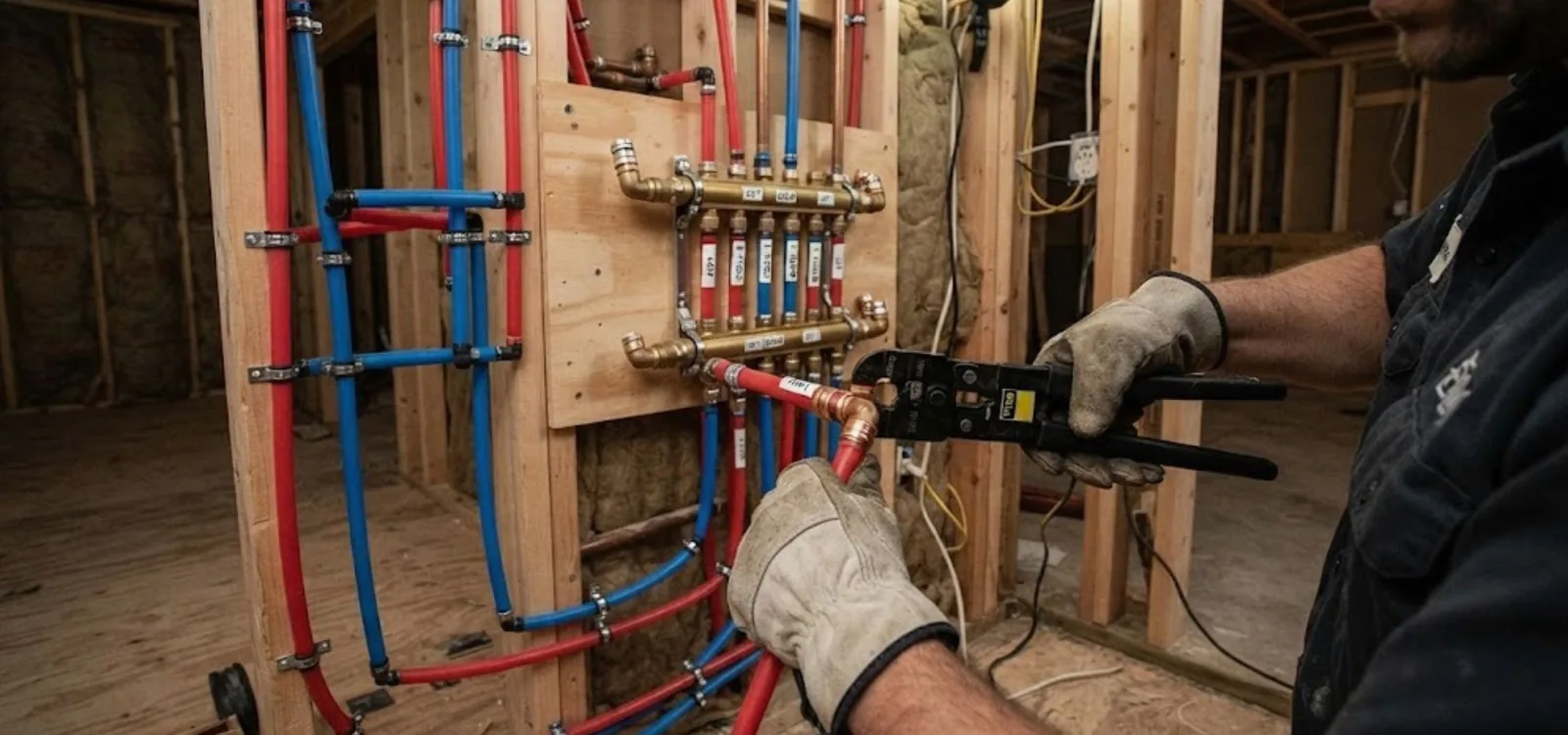
What repiping covers and what it leaves alone
Repiping replaces the hot and cold supply lines that run through walls, floors and ceilings. It does not replace your drain and sewer pipes, and it does not cover the buried line from the street to the house. That outside piece is a different job, covered under water line repair.
Think of the project as new arteries inside the house. The plumber replaces the runs, reconnects the fixtures and valves, and tests the whole system under pressure. Walls are opened only where access requires it, and the plumber should explain where that will be before work starts.
Rusty water, weak pressure and pinhole leaks: what they say about your pipes
These problems share a root cause more often than people expect. When metal supply pipe wears out from the inside, it throws off the same set of symptoms.
- Brown or orange water when you first run a tap, especially after the house sits unused. Rust is flaking off the pipe wall.
- Pressure that drops in some fixtures but not others, or fades over time. Mineral and corrosion buildup narrows the inside of the pipe.
- Tiny leaks that keep appearing in different places, called pinholes. One repair does not stop the next one because the whole run is thinning.
- Stained ceilings or damp wall spots with no obvious source. A slow leak inside a wall is the usual cause.
One leak on a healthy system is a repair. Repeated leaks across the system point to replacement. If you are not sure where a leak is hiding, leak detection can find it first.
Home age in North Ridgeville and why it shapes the decision
North Ridgeville had 13,152 residents in 1970 and 35,280 in 2020, so a large share of its houses went up in the last half century. That tends to mean copper or plastic supply lines rather than old galvanized steel, but it varies by house and by remodel history.
Because of this, the first job is checking what your pipes are made of, not assuming. A plumber can usually tell by looking at the basement runs, a magnet test and a tap on the pipe. If your house is on the older end, galvanized steel is the usual repipe candidate. If it is newer and a single section fails, a spot repair or partial repipe often covers it.
Homes in nearby Elyria, where housing is generally older, show the same pattern, so a neighbor's story is not a reliable guide to your pipes.
Tired of patching the same pipes?
Tell the plumber where the leaks keep showing up and what the water looks like. A walk-through gets you a real number.
How a repipe gets done in an occupied house
- 1Survey the system. The plumber traces supply lines, notes the shutoff and fixture locations and checks the material.
- 2Plan the route. New pipe usually follows the old paths or uses basement joists and attic space to avoid opening more wall than needed.
- 3Shut off and drain. Water is off for the work period, so plan around it. The plumber explains the schedule in advance.
- 4Install new supply lines. Runs are cut, connected and secured, then tied to fixtures and the water heater.
- 5Pressure test and inspect. The system is tested before walls close, and the city inspection happens at the rough stage.
Copper, PEX or a partial repipe: how the choices compare
| Option | How it behaves | Good fit when |
|---|---|---|
| Copper | Rigid, solder or press joints, long track record | You want a traditional metal system and have easy access |
| PEX | Flexible plastic tubing, fewer joints, bends around obstacles | Walls are finished and you want less demolition |
| Partial repipe | Replaces only the failing zone | Damage is limited to one area of the house |
| Spot repair | Fixes one leak, leaves the rest | The rest of the system tests healthy |
Replacing galvanized steel before it fails
Galvanized steel pipe carries a zinc coating that wears away. The corrosion then builds from the inside, so the pipe can look fine from outside while the opening inside is nearly closed. That is why pressure complaints come before leaks.
If your house still has galvanized lines, replacement is usually the permanent answer, because new fittings often cannot be joined cleanly to old corroded threads. Mixing metals can also speed up corrosion at the connection.
What drives the price of a repipe estimate
Anyone who gives you a whole house number over the phone is guessing. A real estimate comes after the plumber walks the house. These are the factors.
More bathrooms, more floors and more fixtures mean more pipe to run and more connections to make.
Copper and PEX differ in material cost and in labor, and the plumber explains the trade-offs for your layout.
Open basement ceilings are straightforward. Finished walls need careful openings and repair.
Hidden damage, old fittings and mixed materials can add steps once the work begins.
The city requires a permit for changes to the water supply, and the inspection schedule can affect timing.
Most homeowner policies cover sudden water damage from a burst pipe but not the replacement of worn pipe itself. Call the line, describe your symptoms, and get a visit scheduled so the price is based on your house.
Permits and choosing the plumber who does the work
North Ridgeville requires a permit for alterations that involve changes to the water supply. Inspections must be scheduled at least 24 hours in advance, and the contractor must be registered with the city. Ask the Building Division at (440) 490-2081 if you want to confirm the details for your house.
New pipe and fittings must meet the Ohio Plumbing Code, which is built on the International Plumbing Code (IPC), and the inspection checks that.
Ohio does not require a state license for residential plumbing contractors, so check proof of insurance, read the written contract, and be wary of anyone who skips the permit or asks for a large down payment. The Ohio Attorney General's Consumer Protection Section takes residential complaints at 1-800-282-0515.
Common questions
Look at how often leaks appear and where. One leak on a sound system is a repair. Pinholes in several places, rust in the water and falling pressure together point to replacement.
Neither wins in every house. Copper is rigid and traditional, PEX is flexible and needs fewer joints. Your plumber should pick based on access, layout and your budget for wall repair.
Yes, for part of each work day. Ask the plumber to schedule shutoffs so you have usable water at night, and plan for a short stretch with no kitchen or bathroom.
It should list the pipe material, the number of fixtures reconnected, how walls will be opened, who repairs drywall and who pulls the permit. If any of those are missing, ask.
Changes to the water supply need one, and permit rules vary, so ask the North Ridgeville Building Division at (440) 490-2081. A plumber who refuses to pull a permit when one is needed is a red flag.