Repair first or replace now
| What you see or hear | Likely cause | Repair or replace |
|---|---|---|
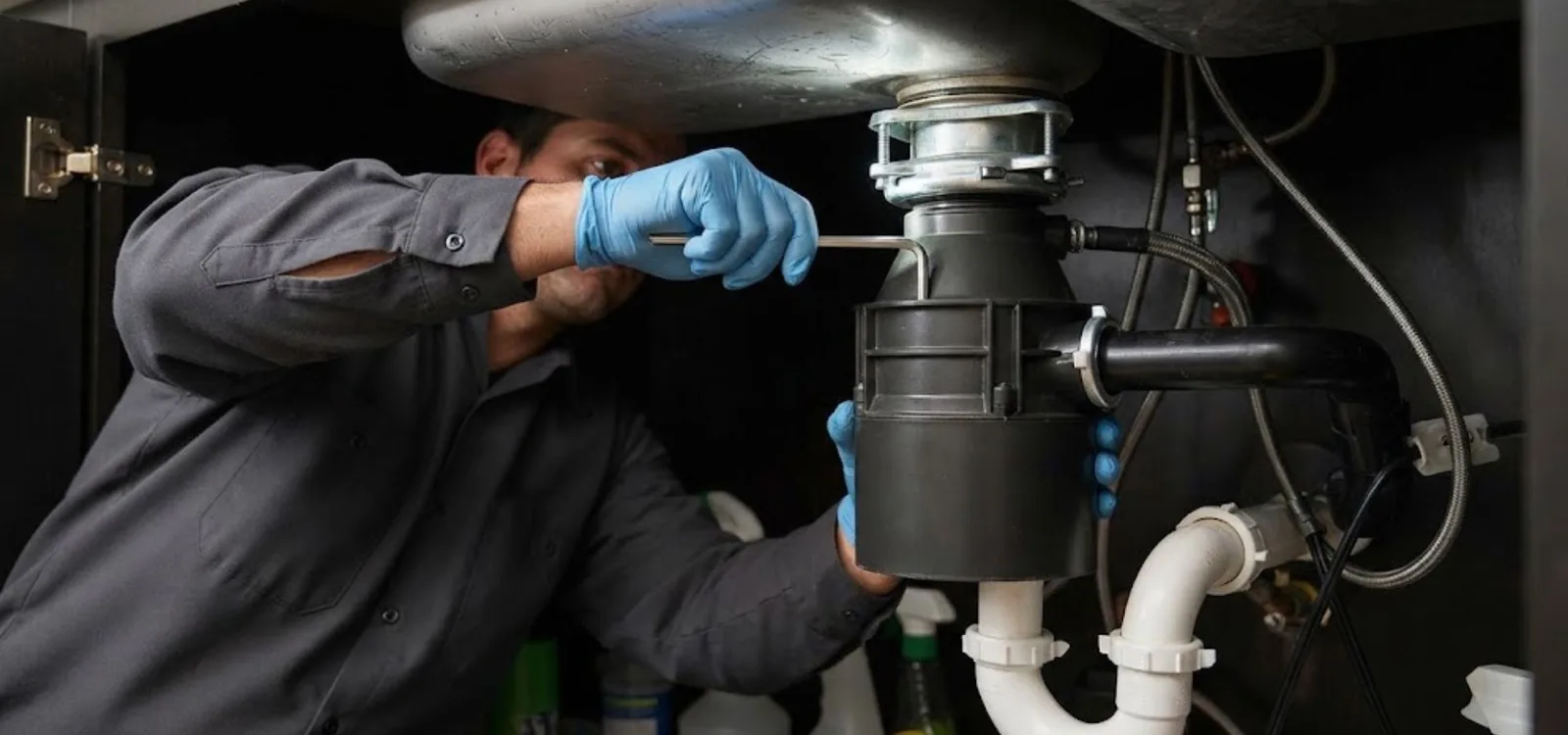
| Humming but no spin | Jammed flywheel | Repair: free the jam with a hex key |
| Nothing at all | Tripped reset or dead switch | Repair: reset, check the switch and outlet |
| Leak from the bottom | Cracked housing or seal failure | Replace |
| Leak at the top ring | Loose or worn mounting | Repair, or replace if corroded |
| Grinds but clogs the drain | Worn grind parts or a pipe problem | Check the pipe, then decide |
A disposal that leaks from the body cannot be sealed. Water is getting through the housing, and a repair that does not fix the housing will fail again. That is when replacement stops being optional.
Where the price comes from
Larger motors handle tougher scraps and run quieter, and they cost more. A household that cooks often benefits from more power, while a small kitchen with light use is fine with a basic unit.
Most units reuse the sink flange. Some sinks need a new mounting assembly, and a double-bowl sink with a dishwasher connection adds connections to check.
A disposal is hardwired or plugged into an outlet under the sink. If the outlet is missing or the switch is faulty, an electrician may be needed, and that is a separate cost.
Old traps and tailpieces are often corroded. Swapping them is inexpensive while the unit is out and a nuisance to do later.
Taking the old one out, hauling it away and cleaning the cabinet are part of the visit. Stuck mounting rings can add time.
An honest number comes after the plumber looks under your sink. Ask what the quote includes, such as the new unit, the connection hardware and haul-away, so you can compare it fairly with another quote.
Where kitchen sink waste ends up in North Ridgeville
Everything that leaves your kitchen sink enters the sanitary sewer system, and in North Ridgeville that system flows to the French Creek Wastewater Treatment Plant in Sheffield Village. A disposal adds food solids to that flow, so it is wise to treat it as a helper for small scraps, not a trash can.
That has a practical side for your sink. Heavy grease and large food loads cause clogs in your own line long before they reach any main. Keep the disposal for light use and the line stays clear.
For permits, rules vary by job. A like-for-like disposal swap is a small project, but if the work alters the water supply or the sanitary sewer, a permit is required. Ask the Building Division at (440) 490-2081 to confirm. Homes in Avon and Sheffield Village drain to the same plant, but their permit offices are their own. The disposal's drain connection follows the Ohio Plumbing Code, built on the International Plumbing Code (IPC).
Disposal dead or leaking?
Call and say what it does when you flip the switch. The plumber can tell you whether it is a reset or a replacement.
What happens on the day
- 1Power off and clear the cabinet. The plumber turns off the breaker or unplugs the unit and empties the space under the sink.
- 2Disconnect the old disposal. The drain pipe, dishwasher hose and mounting ring come off, and the old unit lifts out.
- 3Prep the flange. The sink opening is cleaned and the new mounting assembly is seated with plumber's putty or a gasket.
- 4Mount and connect. The new unit is locked on, the discharge pipe is reconnected, and the dishwasher hose is attached.
- 5Test. Water runs, the disposal grinds, and every joint is checked for drips.
If the dishwasher drains through the disposal, the knockout plug inside the new unit has to be removed. Forgetting it causes dishwasher backups, so ask the plumber to confirm it.
Continuous feed, batch feed and the questions around them
Most kitchens use a continuous feed unit: flip the wall switch and scraps go in while it runs. A batch feed unit only runs when a stopper lid is turned into place, which some households prefer for safety. The mounting and plumbing are similar, but the controls are different, and the lid style needs the right fit at the sink.
Think about who uses the kitchen. A household with young children may want the batch style. A busy cook who rinses a lot of plates may want a continuous feed with a stronger motor. Say what you want when you call, because the plumber can bring the right unit.
Noise is part of the price too. Insulated housings run quieter, and in an open-plan home that matters. If the dishwasher sits on the same drain, the unit also needs the right inlet for the hose.
Questions to ask when you compare quotes
- What is included? The unit, mounting, discharge pipe, dishwasher hookup and haul-away should all be named.
- Is electrical work needed? If the outlet or switch has to be added, that should be a line item.
- What happens to the old trap? A corroded trap replaced now avoids a leak later.
- What is the unit's rated size? Ask the plumber to explain why this size fits your household.
A quote that lists each of these items is easier to compare than a single total. If one number is far lower than another, look for the missing line.
Make the new disposal last
Run cold water before, during and for a short time after grinding. Cold water keeps fats solid so they are chopped and flushed rather than smeared on the pipe walls. Feed scraps gradually, not all at once.
Skip grease, fibrous stalks, bones, pasta and rice in large amounts, and coffee grounds in bulk. If the sink drains slowly even with a healthy disposal, the clog is downstream, and drain cleaning will find it. For a unit that hums or trips, garbage disposal repair is the first call.
Questions we hear
It is a manageable project if you are comfortable with plumbing and basic wiring. The risk is a leak at the flange or a bad electrical connection, and a misconnected dishwasher hose causes backups.
It varies with use and care. Units that see hard use and heavy fats wear sooner, and corrosion at the housing shortens life. A leak at the body ends it.
A disposal grinds but does not clear the pipe beyond it. If the sink is still slow, the clog is in the trap or the drain line, and that needs cabling or jetting.
A disposal needs a dedicated switch and a grounded outlet or hardwired connection. If your sink lacks either, an electrician needs to add them before the plumber can finish.
Not necessarily. Larger motors cost more and use more energy. Match the unit to how much you cook and the size of the household.
Often the trap and tailpiece should be replaced when the unit comes out, especially if they are corroded. It adds little to the job and prevents a leak later.