From cold supply line to hot tap, in order
The whole cycle takes place in a few seconds and repeats every time a fixture opens. Following the water through the unit makes the parts easy to remember.
- 1A tap opens. Water begins to move through the cold inlet, and a flow sensor inside the unit notices the movement.
- 2The control board wakes up. It checks that the flow is above the minimum the unit needs, that the vent is clear and that nothing reports a fault.
- 3Heat turns on. A gas burner ignites or electric elements energize, depending on the model.
- 4Water crosses the heat exchanger. Cold water moves through metal passages that the burner or elements keep hot, and it picks up heat on the way through.
- 5A thermistor watches the outlet. The board raises or lowers the heat so the water leaving the unit stays close to the temperature you set.
- 6The tap closes. Flow stops, the heat shuts off, and the fan on a gas unit runs briefly to clear exhaust gas.
Some units also carry a small recirculation pump or a tiny buffer reservoir. These smooth out the short cold gap that appears when you open a tap after a pause.
Gas or electric: how the two kinds differ
Both types use the same demand-based idea, but the heat source changes the installation more than the operation. A tankless water heater in a house with a gas meter usually uses a burner. An all-electric house uses elements and needs a lot of electrical capacity in the panel.
| Point | Gas tankless | Electric tankless |
|---|---|---|
| Heat source | Burner and heat exchanger | Electric heating elements |
| Venting | Needs a sealed exhaust path to the outdoors | None needed |
| Supply needed | Gas line sized for the burner | Dedicated high-capacity circuit |
| Typical limit | Flow rate at a given temperature rise | Flow rate, often lower for a whole house |
| Common faults | Ignition, venting, scale | Element failure, tripped breaker, scale |
Gas units tend to suit whole-house use where several fixtures run together. Electric units fit a bathroom, a small apartment or a single remote sink more easily, because they skip the vent.
Why flow rate matters more than tank size
A tank is rated by gallons stored. A tankless unit is rated by how much water it can heat per minute and by how many degrees it can raise the incoming temperature. Cold water from a northern Ohio supply line is colder in winter, so the same unit delivers less hot water in January than in July.
Add up what might run at once: a shower, a dishwasher, a washing machine. If their combined demand exceeds the unit's rating, the outlet temperature drops or the unit shuts itself off to protect the exchanger. This is the usual reason a new tankless unit seems to disappoint.
Sizing therefore starts with a list of your fixtures, not with the square footage of the house. A plumber also checks the incoming water temperature range and the gas or electrical supply before choosing a model.
Tankless unit running cold or showing a code?
Describe what the display says and what the water is doing. A plumber on the line can tell you what to check first.
Permit questions before you swap a tank for a tankless unit
The City of North Ridgeville residential permit application lists plumbing work under New, Alteration and Replacement. It also asks for the water heater fuel type and capacity, and the plans show where the water heater will sit. For a tankless unit that means deciding gas or electric and picking a wall location before the paperwork starts, not after.
Permit rules vary, so ask the North Ridgeville Building Division at (440) 490-2081 whether your specific job needs one. Inspections must be scheduled at least 24 hours in advance, so plan the day of the install around that. The same questions come up for homes just across the line in Avon and North Olmsted, but each city runs its own permits.
Why a tankless heater turns lukewarm or throws a code
Most complaints trace back to a short list of causes. Knowing them helps you describe the problem accurately on the phone.
- Scale on the heat exchanger: minerals in the water bake onto the hot metal, narrow the passages and make the unit run hotter and cut out sooner.
- A clogged inlet screen: a small filter at the cold inlet catches grit and can restrict flow below the minimum needed to fire.
- Venting problems: a blocked or loose exhaust path makes a gas unit lock out as a safety measure.
- Too many fixtures at once: demand passes the unit's rating, so the water cools or the burner drops out.
- A cross-connection: a mixing valve or single-handle faucet elsewhere in the house lets cold water bleed into the hot line.
- A failed sensor or board: the unit shows an error code and refuses to start even though plumbing and gas are fine.
An error code on the display points to a circuit or a condition, not always to a broken part. Write down the code and when it appears before you call.
Descaling: the maintenance that keeps the exchanger working
Flushing a tankless unit means circulating a mild descaling solution through the heat exchanger with a small pump and two hoses, then rinsing with clean water. It dissolves scale that has formed on the inside of the passages.
How often it is needed depends on your water, which is something to find out rather than guess. Test your tap, and ask your water utility for its annual water quality report. The City of North Ridgeville Public Utilities Division can be reached at (440) 490-2049, Monday to Friday, 8:00 a.m. to 4:30 p.m.
If your house also has a softener or filter on the main line, scale builds more slowly. That treatment equipment is a separate subject with its own page, and a plumber can tell you whether it makes sense for your setup.
Is it a good fit for your house?
A tankless unit makes sense when you want to reclaim the floor space of a tank, when the household has steady but not extreme hot water use, or when an old tank is failing and you are ready to change the whole arrangement. It is a poorer fit when many fixtures run at once and the gas or electrical supply cannot be upgraded sensibly.
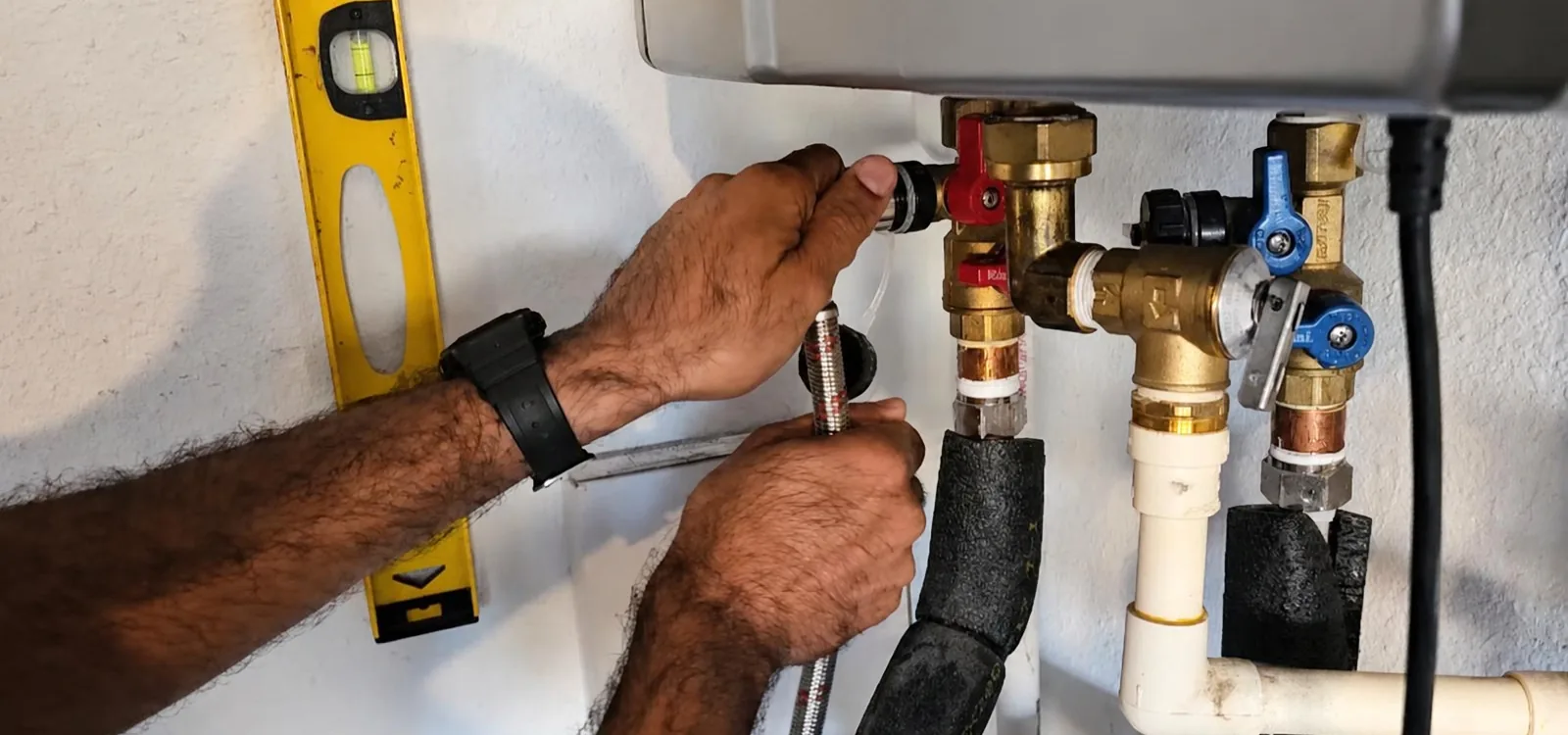
Swapping from a tank to a tankless unit is an installation job, not a repair. It involves new venting or electrical work, a gas line check, isolation valves for flushing and often a condensate drain. Water heater installation covers how that work is planned and priced.
Questions we hear
It gives hot water for as long as the demand stays within its rating. Run more fixtures than the unit can heat at once and the temperature falls, so the supply is continuous but not unlimited in flow.
The pipe between the heater and the tap still holds cooled water from the last use, and the unit also needs a moment to fire. A recirculation loop or a small buffer tank reduces the gap.
Not usually. Even gas models rely on a control board, a fan and an igniter that need electricity. Some homeowners add a small backup power source for the unit.
A gas unit does, with a sealed exhaust path to the outdoors that is sized and routed correctly. Electric units burn no fuel and need no vent.
Common signs are longer waits for hot water, lukewarm output, noisy operation and error codes about the heat exchanger. A plumber can check the flow and the exchanger before deciding.