Start with the meter: the check you can do tonight
The water meter is the simplest leak detector in the house. It counts every drop that passes through the service line, so any movement with everything off means water is escaping somewhere.
- 1Turn everything off. No taps, dishwasher, washer, ice maker or irrigation. Flush nothing.
- 2Find the meter and note the reading, including any small dial or triangle that spins with low flow.
- 3Wait without using water. Leave the house quiet for a while.
- 4Read it again. If the dial moved or the triangle spun, water is leaking between the meter and the fixtures.
- 5Shut the house main and repeat. If the meter stops, the leak is inside. If it keeps moving, the leak is on the line between the meter and the house.
That last step already halves the search. A moving meter with the house main closed points outdoors, which is where water service line repair picks up.
Reading your North Ridgeville meter and who to call about it
The City of North Ridgeville Public Utilities Division handles billing for water, sanitary sewer, stormwater, and refuse and recycling collection for more than 15,000 accounts. Its city website lists water meter pages and a water meter replacement program. If your meter will not read cleanly or seems stuck, call the division at (440) 490-2049, Monday to Friday, 8:00 a.m. to 4:30 p.m.
City Hall is at 7307 Avon Belden Road, which is also where the division works from. Before you call a plumber about a possible high bill, a quick conversation with Public Utilities can confirm whether the reading looks normal for your account. A meter that moves with everything off is the strongest sign the leak is real.
Repairs that touch the water supply need a permit under the city's rules, and permit rules vary, so ask the Building Division at (440) 490-2081. Neighbors in Avon and Elyria have their own utility offices, not North Ridgeville's.
Which tool finds which leak
| Method | What it measures | Best for |
|---|---|---|
| Pressure test | Whether the pipes hold pressure when isolated | Confirming a leak inside or on a branch line |
| Acoustic listening | The sound of water escaping under pressure | Pinpointing leaks in pipes under floors or in the yard |
| Thermal imaging | Temperature differences in walls and floors | Hot water leaks and moisture behind surfaces |
| Moisture meter | Dampness inside drywall, wood or concrete | Confirming wet materials near a suspect spot |
| Tracer gas | Gas escaping from a pipe and rising to the surface | Leaks that are silent or deep |
| Pipe camera | A video view inside drain and sewer lines | Drain leaks and cracked sewer pipe |
No single instrument solves every leak. A technician usually combines two, such as a pressure test to prove the leak exists and a listening device to find it. A slab leak, for example, often needs both.
Meter moving with everything off?
Call the 24/7 line and describe what you found. A plumber can plan the right detection method.
Listening for a leak you cannot see
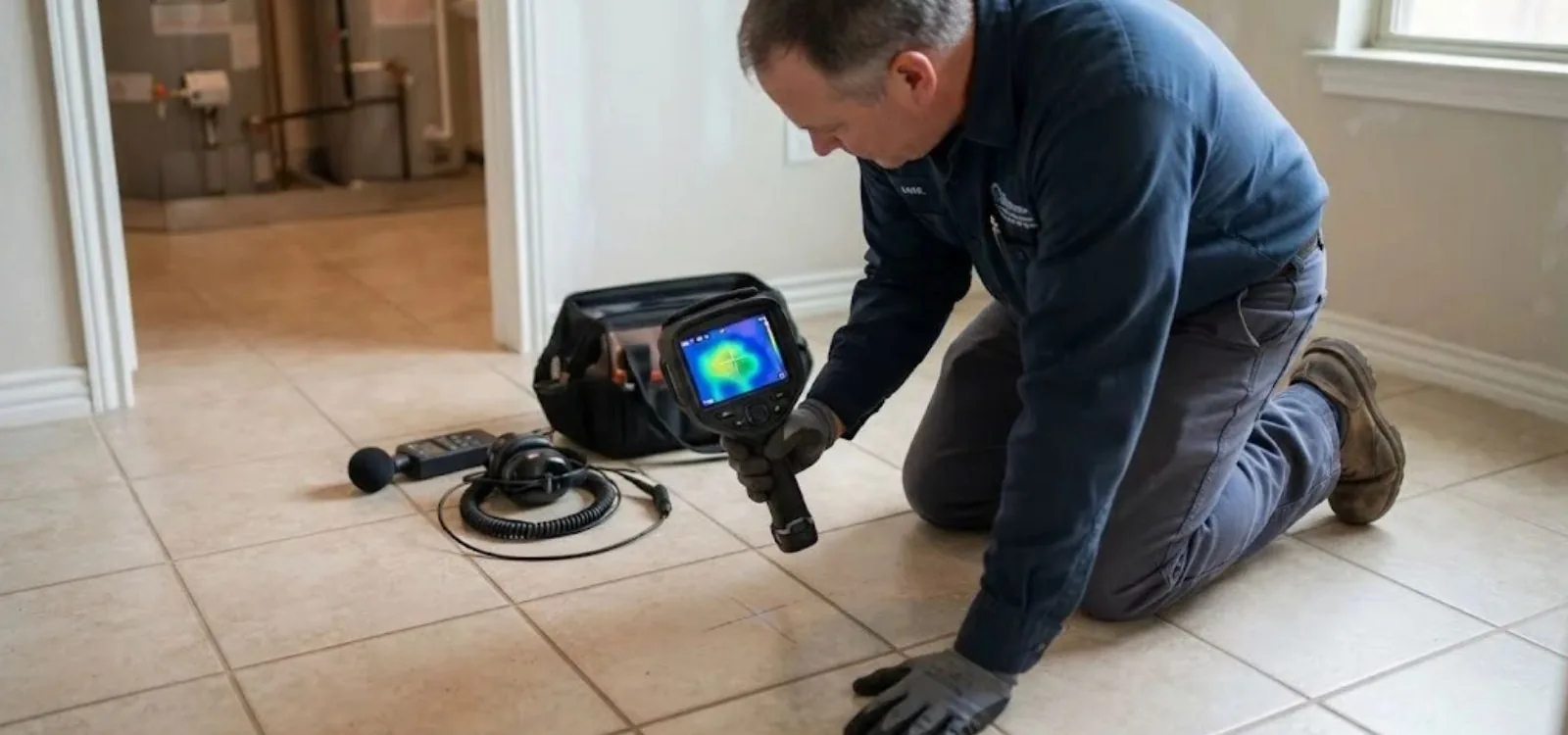
Pressurized water escaping through a crack makes a sound, usually a hiss or a faint rush, even when nothing is audible to the ear. Acoustic gear amplifies it through a ground microphone or a contact sensor placed on floors, walls and valves.
The technician moves along the suspected path and the sound grows stronger as the sensor nears the leak. Where it peaks is the likely spot. This works best when the system is under full pressure and the house is quiet, so the plumber may ask you to turn off appliances and keep everyone still.
Plastic pipe carries sound poorly and concrete muffles it, so a leak under a slab may need thermal imaging or tracer gas to confirm what listening suggests. Our leak detection visits combine methods for that reason.
When the leak is in a drain, not a supply line
Supply lines leak under pressure, so they can be tested and heard. Drain and sewer pipes carry water only when fixtures run, so a leak shows up as damp soil, a smell or a persistent stain with no pressure to test.
That is where a camera earns its place. It travels the line and shows cracks, offset joints and root intrusion directly. A sewer camera inspection confirms whether water is leaving the pipe and where.
Wet spots in the lawn are not always supply leaks. A green, soggy strip along the sewer path often points to waste, not drinking water, and the repair path is completely different.
What happens after the leak is located
Finding the leak is the first half of the job. The second half is deciding how to repair it with the least disruption, and that decision comes from what the detection showed.
A leak in an exposed basement pipe is a short repair. A leak in a wall means opening a small, targeted section of drywall at the spot the instruments marked, not tearing out a whole room. A leak in a buried line means choosing between digging at the marked location and replacing a longer section of pipe.
Ask the plumber to show you what was found before any cutting starts, whether that is a thermal image, a recorded sound reading or a camera clip. You should also get a clear price for the repair before work begins. Pinpoint accuracy is the point of detection, because it keeps the opening small.
Once the repair is done, repeat the meter test. A meter that now holds still with everything off confirms the fix and gives you a baseline for comparison if your water bill climbs again later.
Signs a leak is already costing you
Leaks rarely announce themselves. These are the patterns that send people to the phone:
- A rising water bill with no change in how the household uses water.
- A moving meter when every fixture is off.
- Warm or damp patches on a floor, or a hot spot under carpet.
- A musty smell or discoloration on a ceiling or wall.
- Running water sounds when nothing is on.
- Low pressure at several fixtures at once.
If water is visible and spreading, close the nearest shutoff or the house main and call the 24/7 line. Keep away from wet outlets or electrical equipment.
Questions we hear
You can confirm one. The meter test tells you whether water is escaping and, with the main closed, whether it is inside or outside. Pinpointing a hidden leak usually needs listening or thermal gear.
Not at the detection stage. Listening, thermal imaging and moisture meters work from the surface. Opening a wall or floor comes later, only at the spot that the instruments identify.
Water can run along pipes, soak into insulation or drain into the soil beneath a slab without ever surfacing. That is why the meter and a pressure test matter more than looking for puddles.
Typically with a pressure test to confirm the leak, then acoustic listening and thermal imaging to locate it. Tracer gas is added when the sound is faint.
Shut off the house main and watch whether the meter still moves. If it does, the leak is between the meter and the house, and you also call Public Utilities at (440) 490-2049 about the meter side.
No. Detection finds the leak. Repair fixes it, and sometimes the same visit covers both once the spot is known. A clear price should come before any digging.